
'It is a fiercely fought battle, like our fiery chillies in Guntur.'

Nineteen per cent of global fund managers remain bullish on India, suggests the latest BofA Asia Fund Manager Survey (FMS). A total of 249 panelists with $656 billion worth of assets under management (AUM) participated in the survey between February 2 and 8, BofA said. Two hundred and nine participants with $568 billion AUM responded to the global FMS questions, while 145 participants with $331 billion in AUM responded to the regional fund manager survey (FMS) questions, BofA said.

There is nothing to be worried about as bilateral ties are robust with solid foundations. Both are on the same page on the economic and defence/security ties bilaterally and globally and that shall continue irrespective of change in political dispensation in either country, points out Dr Rajaram Panda.

While the economy has been averaging an annual growth rate of around 8.7 per cent for the last five years, the unorganised manufacturing sector is slowing down.

Indian engineering research and development (ER&D) players, such as Tata Technologies, Tata Elxsi, and Cyient, among others, had a subdued January-March quarter of 2023-24. The outlook for 2024-25 (FY25) also remains unexciting amid weak discretionary spending, prompting analysts to revise their growth expectations for the ongoing financial year (FY25).
President A P J Abdul Kalam on Wednesday mooted eight schemes to generate 56 million direct jobs in the next five years.

Among the Sensex firms, JSW Steel, Tata Steel, Tech Mahindra, Infosys, Wipro, Tata Consultancy Services, Nestle, HCL Technologies, HDFC Bank and Maruti were the major laggards. IndusInd Bank, ITC, Bharti Airtel and State Bank of India were among the winners.
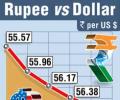
Foreign institutional investors pulled out Rs 86.66 crore (Rs 866.6 million) from local stocks on Monday, as per provisional BSE data.

Increasing migration to cities and urbanisation along with interest from buyers to invest in real estate market, will continue to be the prime demand drivers, according to assurance, tax and advisory firm Grant Thornton.

The growth rate of eight infrastructure sectors of coal, crude oil, natural gas, refinery products, fertilisers, steel, cement and electricity was 5.7 per cent in January 2016.

India's economy grew by 6.3 per cent in the second quarter of the current fiscal, official data released on Wednesday showed.

On the Sensex chart, Vedanta was the biggest loser with 4.66 per cent decline. Other major laggards were were Tata Steel, IndusInd Bank, HDFC Bank, Kotak Bank, Axis Bank, HUL and Bharti Airtel, losing up to 3.36 per cent.

Commerce and Industry Minister Piyush Goyal that the players in the sector should start lowering prices and, if the worst comes to the worst, write off investment as bad business decisions.

The GoC said the security forces have also recovered a huge quantity of narcotics which establishes a deep nexus between defence establishments in Pakistan and terrorist groups.

Newly launched Vistara has a passenger load factor of 55% in the busy Delhi-Mumbai sector, compared with 80-85% in other airlines.

India's largest life insurer, Life Insurance Corporation of India (LIC) reported encouraging performance in the January-March quarter (Q4) of FY24. Total annual premium equivalent (APE) was at Rs 21,180 crore, up 10.7 per cent year-on-year (Y-o-Y), with group APE of Rs 3,890 crore, up 60 per cent Y-o-Y, though individual APE contracted 2.1 per cent Y-o-Y. The participatory book contracted 20.2 per cent Y-o-Y, but the non-par grew by 206 per cent to Rs 3,740 crore.

With the fiscal deficit target staring at the government, the FY25 Budget has limited expenditure options, points out A K Bhattacharya.

Interim Budget, the US Federal policy decision and quarterly earnings will be the major drivers for stock markets which may also see some consolidation this week, say analysts. Besides, investors would also focus on the trading activity of foreign investors and global trends for further cues. From the macroeconomic front, the PMI (Purchasing Managers' Index) data for the manufacturing sector is scheduled to be announced on Thursday.

The slowdown in private consumption in the economy is taking a toll on the growth of fast-moving consumer goods (FMCG). The net sales growth of listed FMCG companies hit a 14-quarter low of 2.5 per cent in October-December 2023 (Q3FY24). This is the lowest revenue growth for the industry since the June 2020 quarter, when the FMCG firms in the Business Standard sample had reported a 13.2 per cent Y-o-Y decline in combined net sales owing to the lockdown.

The revamped Special Economic Zone (SEZ) law is unlikely to see the light of the day before the upcoming Lok Sabha elections, two people aware of the matter said. The commerce department had sought the Union Cabinet's nod to bring amendments to the existing SEZ Act, 2005 late last year. The plan, thereafter, was to introduce the Bill in the winter session of Parliament. Cabinet's approval remains pending.

Between March 2022 and September 2023, HDFC Bank added 56,310 employees.

The surge in deal value is largely due to the $12.9 bn Essar-Rosneft deal

Profitability of realty majors declined by 56 per cent in the first half of 2009-10, which contradicts concerns over formation of a housing bubble in the country.
ICICI Bank on Saturday said its March quarter consolidated net profit grew 18.5 per cent to Rs 11,672 crore, helped by lower provisions. On a standalone basis, the second largest private sector lender showed a 17.4 per cent growth in its profit after tax at Rs 10,708 crore for the reporting quarter against Rs 9,122 crore in the year-ago period. For fiscal 2023-24, its standalone net profit grew to Rs 40,888 crore from Rs 31,896 crore a year ago.
The penalty was levied in connection with deficiencies and lapses in the operation and maintenance of the currency chest at the Secunderabad branch of SBI, it said. Last month, the RBI had imposed a penalty of Rs 3 crore (Rs 30 million) on SBI for violating know your customer/anti-money laundering norms.
Equity benchmark indices Sensex and Nifty buckled under selling pressure after a nine-session rally on Monday, as massive sell-off in IT, tech and telecom counters unnerved investors.

The key infrastructure sectors had grown 5.6 per cent in the same month last year.

An improvement in political relations, anchored in a restoration of peace and tranquillity at the border, could open up opportunities for expanded economic and commercial relations between them, suggests former foreign secretary Ambassador Shyam Saran.

Overall foreign inflows in the country rose by 27%.

Diesel sales in India fell 3 per cent in September as a receding monsoon continued to dampen demand and slowed industrial activity in some parts of the country, preliminary data of state-owned firms showed. While diesel sales by three state-owned fuel retailers fell year-on-year, petrol sales rose in September. Consumption of diesel, the most consumed fuel in the country -- accounting for about two-fifths of the demand, fell to 5.81 million tonnes in September from 5.99 million tonnes demand in the same period a year ago.

Global funds, according to Christopher Wood, global head of equity strategy at Jefferies, are now beginning to pay more attention to India with the market now offering 30 companies with a market capitalisation over $25 billion.

The Indian economy will expand by 5.6 per cent during 2014-15 even as the Reserve Bank is not likely to cut interest rates this year, according to Ficci's latest Economic Outlook Survey.

Among the Sensex firms, ITC, NTPC, Axis Bank, Larsen & Toubro, Bajaj Finance, Asian Paints and Tata Steel were the major gainers. Mahindra & Mahindra, Wipro, Maruti, IndusInd Bank, Kotak Mahindra Bank and HDFC Bank were among the laggards.

India's five leading wilful defaulters are Winsome Diamonds & Jewellery Ltd and associate Forever Precious Jewellery & Diamonds, Zoom Developers, Kingfisher Airlines, Beta Naphthol and Raza Textiles

From the Sensex pack, NTPC, Tata Motors, Titan, Larsen & Toubro, Reliance Industries, IndusInd Bank, Infosys, HDFC Bank and Power Grid were among the major gainers. Wipro and Tech Mahindra were the laggards.

Her reasoning is simple, "It's a Tata company. No shareholder will let go of this opportunity," she told Business Standard. When asked if the other reason for lining up for the IPO is the technology sector and the fact that the combination of Tata and tech is happening after almost two decades, she replied: "The name of the company and the group matter. Tata means stability and credibility," she added.

Merger and acquisition (M&A) deals in the global technology sector amounted to USD 56.4 billion in the July-September quarter of 2011, an increase of 22 per cent vis-a-vis the year-ago period, according to a report by Ernst & Young.

Bangladesh was the largest source of foreign tourists, accounting for 21.4 per cent of all arrivals.

The growth rate in September was highest since May when it was 4.4%.
